what amino acid does the human body use to synthesize melanin?
| Melanin | |
|---|---|
 1 possible structure of Eumelanin | |
| Type | Heterogeneous Biopolymer |
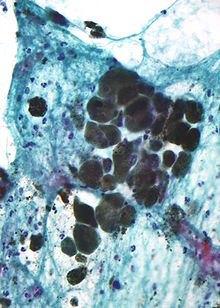
Micrograph of Melanin paint (light refracting granular material—center of image) in a pigmented melanoma.
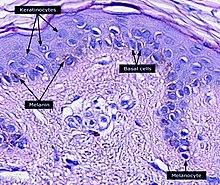
Micrograph of the epidermis, with melanin labeled at left.
Melanin (; from Greek: μέλας, romanized: melas , lit.'black, nighttime') is a broad term for a group of natural pigments institute in most organisms. Melanin is produced through a multistage chemic process known as melanogenesis, where the oxidation of the amino acrid tyrosine is followed by polymerization. The melanin pigments are produced in a specialized group of cells known equally melanocytes. Functionally, melanin serves as protection against UV radiation.
There are v basic types of melanin: eumelanin, pheomelanin, neuromelanin, allomelanin and pyomelanin.[i] The well-nigh common type is eumelanin, of which in that location are two types— brownish eumelanin and black eumelanin. Pheomelanin is a cysteine-derivative that contains polybenzothiazine portions that are largely responsible for the color of red hair, among other pigmentation. Neuromelanin is found in the brain. Enquiry has been undertaken to investigate its efficacy in treating neurodegenerative disorders such as Parkinson's.[ii] Allomelanin and pyomelanin are two types of nitrogen-gratuitous melanin.
In the man skin, melanogenesis is initiated past exposure to UV radiation, causing the pare to darken. Melanin is an effective absorbent of light; the pigment is able to dissipate over 99.9% of absorbed UV radiations.[iii] Considering of this property, melanin is thought to protect skin cells from UVA, UVB radiation harm, reducing the risk of folate depletion and dermal degradation, and it is considered that exposure to UV radiation is associated with increased take chances of malignant melanoma, a cancer of melanocytes (melanin cells). Studies have shown a lower incidence for peel cancer in individuals with more concentrated melanin, i.e. darker pare tone. Yet, the human relationship between skin pigmentation and photoprotection is still uncertain.[iv]
Humans [edit]

In humans, melanin is the primary determinant of skin colour. It is also institute in hair, the pigmented tissue underlying the iris of the eye, and the stria vascularis of the inner ear. In the brain, tissues with melanin include the medulla and paint-begetting neurons within areas of the brainstem, such as the locus coeruleus. It also occurs in the zona reticularis of the adrenal gland.[five]
The melanin in the skin is produced by melanocytes, which are constitute in the basal layer of the epidermis. Although, in general, human beings possess a similar concentration of melanocytes in their skin, the melanocytes in some individuals and ethnic groups produce variable amounts of melanin. Some humans have very fiddling or no melanin synthesis in their bodies, a condition known every bit albinism.[6]
Because melanin is an aggregate of smaller component molecules, in that location are many different types of melanin with unlike proportions and bonding patterns of these component molecules. Both pheomelanin and eumelanin are found in human skin and hair, but eumelanin is the most abundant melanin in humans, also as the form virtually likely to be deficient in albinism.[vii]
Eumelanin [edit]

Part of the structural formula of eumelanin. "(COOH)" can exist COOH or H, or (more rarely) other substituents. The pointer denotes where the polymer continues.
Eumelanin polymers have long been thought to comprise numerous cross-linked 5,6-dihydroxyindole (DHI) and v,6-dihydroxyindole-ii-carboxylic acid (DHICA) polymers.[8]
At that place are two types of eumelanin, which are brown eumelanin and black eumelanin. Those two types of eumelanin chemically differ from each other in their design of polymeric bonds. A pocket-size amount of black eumelanin in the absence of other pigments causes grey hair. A small amount of brown eumelanin in the absenteeism of other pigments causes xanthous (blond) pilus.[9] The eumelanin is present in the peel and hair, etc.
Pheomelanin [edit]

Part of the structural formula of pheomelanin. "(COOH)" tin can be COOH or H, or (more rarely) other substituents. The arrows denote where the polymer continues.
Pheomelanins (or phaeomelanins) impart a range of yellowish to reddish colors.[10] Pheomelanins are specially concentrated in the lips, nipples, glans of the penis, and vagina.[11] When a modest corporeality of brown eumelanin in pilus, which would otherwise crusade blond hair, is mixed with ruby pheomelanin, the effect is orangish hair, which is typically called "ruby" or "ginger" hair. Pheomelanin is also present in the peel, and redheads consequently ofttimes have a more pinkish hue to their skin as well.
In chemical terms, pheomelanins differ from eumelanins in that the oligomer construction incorporates benzothiazine and benzothiazole units that are produced,[12] instead of DHI and DHICA, when the amino acrid L-cysteine is present.
Trichochromes [edit]
Trichochromes (formerly chosen trichosiderins) are pigments produced from the same metabolic pathway as the eumelanins and pheomelanins, but unlike those molecules they have low molecular weight. They occur in some ruby human pilus.[13]
Neuromelanin [edit]
Neuromelanin (NM) is a dark insoluble polymer pigment produced in specific populations of catecholaminergic neurons in the brain. Humans have the largest amount of NM, which is present in lesser amounts in other primates, and totally absent in many other species.[14] The biological function remains unknown, although human NM has been shown to efficiently bind transition metals such as fe, likewise every bit other potentially toxic molecules. Therefore, it may play crucial roles in apoptosis and the related Parkinson's disease.[15]
Other organisms [edit]
Melanins have very various roles and functions in diverse organisms. A course of melanin makes up the ink used by many cephalopods (run into cephalopod ink) every bit a defense machinery against predators. Melanins also protect microorganisms, such every bit bacteria and fungi, against stresses that involve cell impairment such equally UV radiations from the dominicus and reactive oxygen species. Melanin also protects against damage from high temperatures, chemical stresses (such equally heavy metals and oxidizing agents), and biochemical threats (such as host defenses against invading microbes).[16] Therefore, in many pathogenic microbes (for example, in Cryptococcus neoformans, a fungus) melanins appear to play important roles in virulence and pathogenicity by protecting the microbe against allowed responses of its host. In invertebrates, a major aspect of the innate immune defence force organisation against invading pathogens involves melanin. Inside minutes after infection, the microbe is encapsulated within melanin (melanization), and the generation of costless radical byproducts during the formation of this capsule is thought to aid in killing them.[17] Some types of fungi, called radiotrophic fungi, appear to be able to apply melanin every bit a photosynthetic pigment that enables them to capture gamma rays[eighteen] and harness this energy for growth.[19]
The darker feathers of birds owe their colour to melanin and are less readily degraded by bacteria than unpigmented ones or those containing carotenoid pigments.[20] Feathers that comprise melanin are also 39% more resistant to chafe than those that do non because melanin granules help fill the space between the keratin strands that course feathers.[21] [22] Pheomelanin synthesis in birds implies the consumption of cysteine, a semi‐essential amino acid that is necessary for the synthesis of the antioxidant glutathione (GSH) but that may be toxic if in excess in the diet. Indeed, many carnivorous birds, which accept a high poly peptide content in their diet, exhibit pheomelanin‐based coloration.[23]
Melanin is also important in mammalian pigmentation.[24] The coat pattern of mammals is determined by the agouti factor which regulates the distribution of melanin.[25] [26] The mechanisms of the factor have been extensively studied in mice to provide an insight into the diversity of mammalian coat patterns.[27]
Melanin in arthropods has been observed to be deposited in layers thus producing a Bragg reflector of alternating refractive index. When the calibration of this pattern matches the wavelength of visible light, structural coloration arises: giving a number of species an iridescent color.[28]
Arachnids are one of the few groups in which melanin has non been easily detected, though researchers institute data suggesting spiders practice in fact produce melanin.[29]
Some moth species, including the wood tiger moth, convert resources to melanin in guild to enhance their thermoregulation. As the wood tiger moth has populations over a large range of latitudes, it has been observed that more northern populations showed higher rates of melanization. In both xanthous and white male phenotypes of the woods tiger moth, individuals with more melanin had a heightened ability to trap heat simply an increased predation rate due to a weaker and less effective aposematic signal.[30]
Melanin protects Drosophila flies and mice confronting Dna damage from non-UV radiation.[31] Important studies in Drosophila models include Hopwood et al., 1985.[31] Much of our understanding of the radioprotective furnishings of melanin against gamma radiation come from the laboratories and inquiry groups of Irma Mosse.[32] [33] [34] [35] [36] [37] [38] : 1151 Mosse began in radiobiology in the Soviet era, was increasingly supported by government funding in the wake of the discovery of radiotrophic microbes in Chernobyl, and as of 2022[update] continues under the Belarussian Institute of Genetics and Cytology.[37] Her most significant contribution is Mosse et al., 2000 on mice[32] [33] [34] [35] [36] [37] [38] : 1151 but also includes Mosse et al., 1994,[36] Mosse et al., 1997,[36] Mosse et al., 1998,[35] Mosse et al., 2001,[36] Mosse et al., 2002,[35] [36] Mosse et al., 2006,[35] [36] Mosse et al., 2007[36] and Mosse et al., 2008.[36]
Plants [edit]

Chemical structure of indole-5,six-quinone
Melanin produced by plants are sometimes referred to as 'catechol melanins' as they can yield catechol on alkali fusion. It is commonly seen in the enzymatic browning of fruits such as bananas. Anecdote shell melanin can be used as an antioxidant and coloring amanuensis.[39] Biosynthesis involves the oxidation of indole-5,6-quinone by the tyrosinase type polyphenol oxidase from tyrosine and catecholamines leading to the formation of catechol melanin. Despite this many plants incorporate compounds which inhibit the production of melanins.[40]
Interpretation as a unmarried monomer [edit]
Information technology is now understood that melanins exercise non have a unmarried structure or stoichiometry. Nonetheless, chemical databases such as PubChem include structural and empirical formulae; typically 3,eight-Dimethyl-ii,vii-dihydrobenzo[1,2,3-cd:4,5,six-c′d′]diindole-4,5,9,x-tetrone. This can be idea of as a single monomer that accounts for the measured elemental limerick and some properties of melanin, but is unlikely to be institute in nature.[41] Solano[42] claims that this misleading trend stems from a study of an empirical formula in 1948,[43] but provides no other historical item.
![3,8-Dimethyl-2,7-dihydrobenzo[1,2,3-cd:4,5,6-c′d′]diindole-4,5,9,10-tetrone](https://upload.wikimedia.org/wikipedia/commons/thumb/2/20/Melanin.svg/240px-Melanin.svg.png) | |
![3,8-Dimethyl-2,7-dihydrobenzo[1,2,3-cd:4,5,6-c′d′]diindole-4,5,9,10-tetrone ball and stick model](https://upload.wikimedia.org/wikipedia/commons/thumb/7/7b/Melanin_ball_and_stick.png/240px-Melanin_ball_and_stick.png) | |
| Names | |
|---|---|
| Preferred IUPAC proper noun 3,viii-Dimethyl-2,vii-dihydrobenzo[i,ii,3-cd:4,5,6-c′d′]diindole-4,5,nine,10-tetrone | |
| Identifiers | |
| CAS Number |
|
| ChemSpider |
|
| PubChem CID |
|
| Properties | |
| Chemical formula | C 18 H 10 N ii O four |
| Tooth mass | 318.288 g·mol−1 |
| Density | 1.6 to i.8 k/cmiii |
| Melting bespeak | < −20 °C (−4 °F; 253 K) |
| Boiling point | 450 to 550 °C (842 to i,022 °F; 723 to 823 K) |
| Except where otherwise noted, data are given for materials in their standard state (at 25 °C [77 °F], 100 kPa). | |
| Infobox references | |

Biosynthetic pathways [edit]
The first step of the biosynthetic pathway for both eumelanins and pheomelanins is catalysed by tyrosinase.[44]
- Tyrosine → DOPA → dopaquinone
Dopaquinone can combine with cysteine past ii pathways to benzothiazines and pheomelanins
- Dopaquinone + cysteine → 5-S-cysteinyldopa → benzothiazine intermediate → pheomelanin
- Dopaquinone + cysteine → 2-Due south-cysteinyldopa → benzothiazine intermediate → pheomelanin
Also, dopaquinone tin exist converted to leucodopachrome and follow two more than pathways to the eumelanins
- Dopaquinone → leucodopachrome → dopachrome → five,6-dihydroxyindole-2-carboxylic acrid → quinone → eumelanin
- Dopaquinone → leucodopachrome → dopachrome → 5,six-dihydroxyindole → quinone → eumelanin
Detailed metabolic pathways can be found in the KEGG database (see External links).
-

L-tyrosine
-

Fifty-DOPA
-

L-dopaquinone
-

L-leucodopachrome
-

L-dopachrome
Microscopic appearance [edit]
Melanin is brown, non-refractile, and finely granular with individual granules having a bore of less than 800 nanometers. This differentiates melanin from common blood breakdown pigments, which are larger, mesomorphic, and refractile, and range in color from greenish to xanthous or red-brown. In heavily pigmented lesions, dense aggregates of melanin can obscure histologic detail. A dilute solution of potassium permanganate is an effective melanin bleach.[45]
Genetic disorders and affliction states [edit]
In that location are approximately nine types of oculocutaneous albinism, which is more often than not an autosomal recessive disorder. Certain ethnicities have higher incidences of different forms. For instance, the most mutual type, called oculocutaneous albinism blazon 2 (OCA2), is especially frequent among people of black African descent and white Europeans. People with OCA2 ordinarily have off-white peel, only are oft non as pale as OCA1. They (OCA2 or OCA1? run into comments in History) have pale blonde to gold, strawberry blonde, or even brown hair, and most commonly blue eyes. 98.7–100% of mod Europeans are carriers of the derived allele SLC24A5, a known cause of nonsyndromic oculocutaneous albinism. It is an autosomal recessive disorder characterized by a congenital reduction or absence of melanin paint in the pare, hair, and eyes. The estimated frequency of OCA2 among African-Americans is one in ten,000, which contrasts with a frequency of 1 in 36,000 in white Americans.[46] In some African nations, the frequency of the disorder is even higher, ranging from 1 in 2,000 to 1 in 5,000.[47] Another form of Albinism, the "yellow oculocutaneous albinism", appears to be more than prevalent among the Amish, who are of primarily Swiss and High german beginnings. People with this IB variant of the disorder commonly take white hair and skin at birth, but rapidly develop normal pare pigmentation in infancy.[47]
Ocular albinism affects not only heart pigmentation just visual acuity, also. People with albinism typically test poorly, inside the 20/60 to 20/400 range. In addition, 2 forms of albinism, with approximately one in ii,700 almost prevalent among people of Puerto Rican origin, are associated with mortality beyond melanoma-related deaths.
The connection between albinism and deafness is well known, though poorly understood. In his 1859 treatise On the Origin of Species, Charles Darwin observed that "cats which are entirely white and accept blue eyes are generally deaf".[48] In humans, hypopigmentation and deafness occur together in the rare Waardenburg's syndrome, predominantly observed among the Hopi in N America.[49] The incidence of albinism in Hopi Indians has been estimated equally approximately 1 in 200 individuals. Similar patterns of albinism and deafness take been found in other mammals, including dogs and rodents. However, a lack of melanin per se does not appear to exist directly responsible for deafness associated with hypopigmentation, equally most individuals defective the enzymes required to synthesize melanin accept normal auditory role.[l] Instead, the absence of melanocytes in the stria vascularis of the inner ear results in cochlear impairment,[51] though why this is, is not fully understood.
In Parkinson's disease, a disorder that affects neuromotor functioning, there is decreased neuromelanin in the substantia nigra and locus coeruleus as a issue of specific dropping out of dopaminergic and noradrenergic pigmented neurons. This results in diminished dopamine and norepinephrine synthesis. While no correlation between race and the level of neuromelanin in the substantia nigra has been reported, the significantly lower incidence of Parkinson'southward in blacks than in whites has "prompt[ed] some to suggest that cutaneous melanin might somehow serve to protect the neuromelanin in substantia nigra from external toxins."[52]
In add-on to melanin deficiency, the molecular weight of the melanin polymer may be decreased by diverse factors such every bit oxidative stress, exposure to light, perturbation in its association with melanosomal matrix proteins, changes in pH, or in local concentrations of metallic ions. A decreased molecular weight or a decrease in the degree of polymerization of ocular melanin has been proposed to turn the normally anti-oxidant polymer into a pro-oxidant. In its pro-oxidant state, melanin has been suggested to exist involved in the causation and progression of macular degeneration and melanoma.[53] Rasagiline, an of import monotherapy drug in Parkinson'south affliction, has melanin binding backdrop, and melanoma tumor reducing properties.[54]
Higher eumelanin levels also can be a disadvantage, withal, beyond a higher disposition toward vitamin D deficiency. Nighttime pare is a complicating gene in the laser removal of port-wine stains. Effective in treating white peel, in general, lasers are less successful in removing port-wine stains in people of Asian or African descent. Higher concentrations of melanin in darker-skinned individuals just diffuse and absorb the laser radiation, inhibiting lite assimilation by the targeted tissue. In a like manner, melanin tin complicate laser treatment of other dermatological conditions in people with darker skin.
Freckles and moles are formed where at that place is a localized concentration of melanin in the skin. They are highly associated with pale skin.
Nicotine has an affinity for melanin-containing tissues considering of its precursor function in melanin synthesis or its irreversible binding of melanin. This has been suggested to underlie the increased nicotine dependence and lower smoking abeyance rates in darker pigmented individuals.[55]
Human being accommodation [edit]
Physiology [edit]
Melanocytes insert granules of melanin into specialized cellular vesicles called melanosomes. These are and so transferred into the keratinocyte cells of the man epidermis. The melanosomes in each recipient cell accrue atop the cell nucleus, where they protect the nuclear DNA from mutations caused by the ionizing radiations of the sun's ultraviolet rays. In general, people whose ancestors lived for long periods in the regions of the globe near the equator accept larger quantities of eumelanin in their skins. This makes their skins brown or black and protects them against high levels of exposure to the sun, which more frequently consequence in melanomas in lighter-skinned people.[56]
Not all the effects of pigmentation are advantageous. Pigmentation increases the heat load in hot climates, and dark-skinned people blot 30% more than heat from sunlight than do very lite-skinned people, although this gene may be offset by more profuse sweating. In cold climates dark pare entails more than heat loss by radiation. Pigmentation also hinders synthesis of vitamin D, so that in areas of poor nutrition darker skinned children are more liable to rickets than lighter skinned children. Since pigmentation appears to be not entirely advantageous to life in the torrid zone, other hypotheses most its biological significance have been advanced, for example a secondary phenomenon induced by adaptation to parasites and tropical diseases.[57]
Evolutionary origins [edit]
Early on humans evolved to accept dark skin color around 1.ii million years ago, as an adaptation to a loss of body pilus that increased the furnishings of UV radiation. Earlier the development of hairlessness, early humans had reasonably light skin underneath their fur, like to that found in other primates.[58] The most contempo scientific testify indicates that anatomically modern humans evolved in Africa betwixt 200,000 and 100,000 years,[59] and then populated the rest of the globe through one migration between eighty,000 and fifty,000 years agone, in some areas interbreeding with sure archaic human species (Neanderthals, Denisovans, and possibly others).[lx] It seems probable that the first modern humans had relatively large numbers of eumelanin-producing melanocytes, producing darker skin similar to the indigenous people of Africa today. Equally some of these original people migrated and settled in areas of Asia and Europe, the selective pressure for eumelanin production decreased in climates where radiation from the sun was less intense. This somewhen produced the current range of human skin colour. Of the 2 common gene variants known to be associated with pale human being skin, Mc1r does not appear to take undergone positive selection,[61] while SLC24A5 has undergone positive selection.[62]
Effects [edit]
As with peoples having migrated northward, those with low-cal pare migrating toward the equator acclimatize to the much stronger solar radiations. Nature selects for less melanin when ultraviolet radiation is weak. Most people's skin darkens when exposed to UV light, giving them more protection when information technology is needed. This is the physiological purpose of sun tanning. Dark-skinned people, who produce more skin-protecting eumelanin, take a greater protection confronting sunburn and the development of melanoma, a potentially deadly class of skin cancer, as well as other health bug related to exposure to potent solar radiation, including the photodegradation of certain vitamins such as riboflavins, carotenoids, tocopherol, and folate.[63] Some Northwestern Europeans have substantially lost the ability to tan as a consequence of relaxed natural selection. Their skin burns and peels rather than tans. This is due to the fact that they produce a defective form of a skin protein Mc1r (melanocortin-one receptor) which is necessary for the product of melanin. They are at a distinct disadvantage in tropical and subtropical environments. Non but do they suffer the discomfort of readily burning, but they are at a much higher take a chance for peel cancer; the aforementioned is true of albinos.[64]
Melanin in the eyes, in the iris and choroid, helps protect them from ultraviolet and loftier-frequency visible lite; people with greyness, blue, and green eyes are more at risk of sun-related eye problems. Further, the ocular lens yellows with historic period, providing added protection. However, the lens also becomes more rigid with age, losing well-nigh of its accommodation—the ability to change shape to focus from far to near—a detriment due probably to poly peptide crosslinking caused by UV exposure.
Contempo research suggests that melanin may serve a protective function other than photoprotection.[65] Melanin is able to effectively chelate metal ions through its carboxylate and phenolic hydroxyl groups, in many cases much more efficiently than the powerful chelating ligand ethylenediaminetetraacetate (EDTA). Thus, it may serve to sequester potentially toxic metal ions, protecting the rest of the cell. This hypothesis is supported by the fact that the loss of neuromelanin observed in Parkinson'southward disease is accompanied by an increase in iron levels in the brain.
Physical properties and technological applications [edit]
Prove exists in back up of a highly cross-linked heteropolymer spring covalently to matrix scaffolding melanoproteins.[66] It has been proposed that the ability of melanin to human activity as an antioxidant is directly proportional to its degree of polymerization or molecular weight.[67] Suboptimal weather for the effective polymerization of melanin monomers may lead to germination of lower-molecular-weight, pro-oxidant melanin that has been implicated in the causation and progression of macular degeneration and melanoma.[68] Signaling pathways that upregulate melanization in the retinal pigment epithelium (RPE) also may exist implicated in the downregulation of rod outer segment phagocytosis past the RPE. This miracle has been attributed in part to foveal sparing in macular degeneration.[69]
Role in melonoma metastasis [edit]
The research washed by Sarna'south team proved that heavily pigmented melanoma cells have Young's modulus about iv.93, when in non-pigmented ones it was but 0.98.[70] In another experiment they found that elasticity of melanoma cells is of import for its metastasis and growth: non-pigmented tumors were bigger than pigmented and information technology was much easier for them to spread. They shown that at that place are both pigmented and not-pigmented cells in melanoma tumors, so that they can both be drug-resistant and metastatic.[70]
See also [edit]
- Albino
- Albinism in biology
- Ferulic acid
- Griscelli syndrome, a syndrome characterised by hypopigmentation
- Human skin color
- Melanin theory
- Melanism
- Melanogenesis, melanin product
- Risks and benefits of sunday exposure
- Skin whitening
- Vitamin D
References [edit]
- ^ Cao, Wei; Zhou, Xuhao; McCallum, Naneki C.; Hu, Ziying; Ni, Qing Zhe; Kapoor, Utkarsh; Heil, Christian M.; Cay, Kristine S.; Zand, Tara; Mantanona, Alex J.; Jayaraman, Arthi (2021-02-09). "Unraveling the Structure and Function of Melanin through Synthesis". Journal of the American Chemical Society. 143 (7): 2622–2637. doi:10.1021/jacs.0c12322. hdl:1854/LU-8699336. ISSN 0002-7863. PMID 33560127. S2CID 231872855.
- ^ Haining, Robert 50.; Achat-Mendes, Cindy (March 2017). "Neuromelanin, 1 of the almost overlooked molecules in modern medicine, is not a spectator". Neural Regeneration Research. 12 (3): 372–375. doi:10.4103/1673-5374.202928. PMC5399705. PMID 28469642.
- ^ Meredith P, Riesz J (2004). "Radiative relaxation breakthrough yields for synthetic eumelanin". Photochemistry and Photobiology. 79 (two): 211–6. arXiv:cond-mat/0312277. doi:10.1111/j.1751-1097.2004.tb00012.x. PMID 15068035. S2CID 222101966.
- ^ Brenner Yard, Hearing VJ (2008). "The protective office of melanin against UV harm in human skin". Photochemistry and Photobiology. 84 (3): 539–49. doi:10.1111/j.1751-1097.2007.00226.x. PMC2671032. PMID 18435612.
- ^ Solano, F. (2014). "Melanins: Skin Pigments and Much More—Types, Structural Models, Biological Functions, and Formation Routes". New Periodical of Scientific discipline. 2014: i–28. doi:10.1155/2014/498276.
- ^ Cichorek, Mirosława; Wachulska, Małgorzata; Stasiewicz, Aneta; Tymińska, Agata (February 20, 2013). "Skin melanocytes: biological science and development". Advances in Dermatology and Allergology. 30 (one): 30–41. doi:10.5114/pdia.2013.33376. PMC3834696. PMID 24278043.
- ^ "oculocutaneous albinism". Genetics Home Reference . Retrieved 2017-09-25 .
- ^ Meredith, Paul; Sarna, Tadeusz (2006-12-01). "The physical and chemic properties of eumelanin". Paint Cell Research. nineteen (6): 572–594. doi:10.1111/j.1600-0749.2006.00345.x. PMID 17083485.
- ^ Ito, S.; Wakamatsu, K. (December 2011). "Diversity of human hair pigmentation equally studied by chemical assay of eumelanin and pheomelanin". Journal of the European Academy of Dermatology and Venereology. 25 (12): 1369–1380. doi:10.1111/j.1468-3083.2011.04278.x. ISSN 1468-3083. PMID 22077870. S2CID 5121042.
- ^ Slominski A, Tobin DJ, Shibahara Southward, Wortsman J (October 2004). "Melanin pigmentation in mammalian peel and its hormonal regulation". Physiological Reviews. 84 (four): 1155–228. doi:10.1152/physrev.00044.2003. PMID 15383650. S2CID 21168932.
- ^ "pheomelanin". MetaCyc Metabolic Pathway Database. 2010. [ full commendation needed ]
- ^ Greco K, Panzella L, Verotta L, d'Ischia M, Napolitano A (Apr 2011). "Uncovering the construction of homo red pilus pheomelanin: benzothiazolylthiazinodihydroisoquinolines as central building blocks". Journal of Natural Products. 74 (4): 675–82. doi:10.1021/np100740n. PMID 21341762.
- ^ Prota, Thou.; Searle, A. G. (1978). "Biochemical sites of gene action for melanogenesis in mammals". Annales de Génétique et de Sélection Animale. 10 (1): ane–8. doi:ten.1186/1297-9686-10-1-i. PMC2757330. PMID 22896083.
- ^ Fedorow H, Tribl F, Halliday G, Gerlach Yard, Riederer P, Double KL (2005). "Neuromelanin in human being dopamine neurons: comparison with peripheral melanins and relevance to Parkinson's disease". Prog Neurobiol. 75 (ii): 109–124. doi:10.1016/j.pneurobio.2005.02.001. PMID 15784302. S2CID 503902.
- ^ Double KL (2006). "Functional effects of neuromelanin and synthetic melanin in model systems". J Neural Transm. 113 (6): 751–756. doi:10.1007/s00702-006-0450-v. PMID 16755379. S2CID 23096297.
- ^ Hamilton AJ, Gomez BL (March 2002). "Melanins in fungal pathogens". Journal of Medical Microbiology. 51 (3): 189–91. doi:10.1099/0022-1317-51-3-189. PMID 11871612.
- ^ Cerenius L, Söderhäll K (April 2004). "The prophenoloxidase-activating arrangement in invertebrates". Immunological Reviews. 198: 116–26. doi:10.1111/j.0105-2896.2004.00116.ten. PMID 15199959. S2CID 10614298.
- ^ Castelvecchi, Davide (May 26, 2007). "Dark Power: Pigment seems to put radiations to expert employ". Science News. 171 (21): 325. doi:10.1002/scin.2007.5591712106.
- ^ Dadachova Eastward, Bryan RA, Huang 10, et al. (2007). "Ionizing radiation changes the electronic properties of melanin and enhances the growth of melanized fungi". PLOS ONE. two (5): e457. Bibcode:2007PLoSO...ii..457D. doi:10.1371/journal.pone.0000457. PMC1866175. PMID 17520016.
- ^ Gunderson, Alex R.; Frame, Alicia Chiliad.; Swaddle, John P.; Forsyth, Marker H. (2008-09-01). "Resistance of melanized feathers to bacterial degradation: is it really so blackness and white?". Journal of Avian Biology. 39 (5): 539–545. doi:10.1111/j.0908-8857.2008.04413.x.
- ^ Bonser, Richard H. C. (1995). "Melanin and the Abrasion Resistance of Feathers". Condor. 97 (two): 590–591. doi:ten.2307/1369048. JSTOR 1369048.
- ^ Galván, Ismael; Solano, Francisco (2016-04-08). "Bird Integumentary Melanins: Biosynthesis, Forms, Part and Evolution". International Journal of Molecular Sciences. 17 (4): 520. doi:ten.3390/ijms17040520. PMC4848976. PMID 27070583.
- ^ Rodríguez‐Martínez, Sol; Galván, Ismael (2020). "Juvenile pheomelanin-based feather coloration has evolved more frequently in carnivorous species". Ibis. 162 (1): 238–244. doi:x.1111/ibi.12770. hdl:10261/207451. ISSN 1474-919X. S2CID 202018215.
- ^ Jimbow, K; Quevedo WC, Jr; Fitzpatrick, TB; Szabo, One thousand (Jul 1976). "Some aspects of melanin biology: 1950–1975". The Periodical of Investigative Dermatology. 67 (ane): 72–89. doi:10.1111/1523-1747.ep12512500. PMID 819593.
- ^ Meneely, Philip (2014). Genetic Assay: Genes, Genomes, and Networks in Eukaryotes. Oxford University Printing. ISBN9780199681266.
- ^ Griffiths, Anthony JF; Miller, Jeffrey H.; Suzuki, David T.; Lewontin, Richard C.; Gelbart, William M. (2000). "Gene interaction in coat colour of mammals".
- ^ Millar, S. East.; Miller, M. W.; Stevens, M. Eastward.; Barsh, G. S. (October 1995). "Expression and transgenic studies of the mouse agouti gene provide insight into the mechanisms by which mammalian coat color patterns are generated". Development. 121 (10): 3223–3232. doi:ten.1242/dev.121.10.3223. PMID 7588057.
- ^ Neville, A. C. (2012). Biology of the Arthropod Cuticle. Springer Science & Business organisation Media. ISBN9783642809101.
- ^ Hsiung, B.-K.; Blackledge, T. A.; Shawkey, M. D. (2015). "Spiders practise have melanin afterward all". Periodical of Experimental Biology. 218 (22): 3632–3635. doi:x.1242/jeb.128801. PMID 26449977.
- ^ Hegna, Robert H.; Nokelainen, Ossi; Hegna, Jonathan R.; Mappes, Johanna (2013). "To quiver or to shiver: increased melanization benefits thermoregulation, but reduces warning betoken efficacy in the forest tiger moth". Proc. R. Soc. B. 280 (1755): 20122812. doi:10.1098/rspb.2012.2812. PMC3574392. PMID 23363631.
- ^ a b Mosse, Irma B.; Dubovic, Boris Five.; Plotnikova, Svetlana I.; Kostrova, Ludmila N.; Molophei, Vadim; Subbot, Svetlana T.; Maksimenya, Inna P. (20–25 May 2001). Obelic, B.; Ranogajev-Komor, Chiliad.; Miljanic, S.; Krajcar Bronic, I. (eds.). Melanin is Effective Radioprotector against Chronic Irradiation and Low Radiation Doses. IRPA Regional Congress on Radiation Protection in Cardinal Europe: Radiation Protection and Health. INIS. Dubrovnik (Croatia): Croatian Radiation Protection Association. p. 35 (of 268).
{{cite conference}}: CS1 maint: date format (link) - ^ a b Gessler, N. Due north.; Egorova, A. Due south.; Belozerskaya, T. A. (2014). "Melanin pigments of fungi nether extreme environmental atmospheric condition (Review)". Applied Biochemistry and Microbiology. Pleiades Publishing. 50 (2): 105–113. doi:x.1134/s0003683814020094. ISSN 0003-6838.
- ^ a b Nenoi, M; Wang, B; Vares, One thousand (2014-06-12). "In vivo radioadaptive response". Toxicology. Sage. 34 (3): 272–283. doi:10.1177/0960327114537537. ISSN 0960-3271.
- ^ a b Liu, Heng; Yang, Youyuan; Liu, Yu; Pan, Jingjing; Wang, Junqing; Homo, Fengyuan; Zhang, Weiguo; Liu, Gang (2020-02-07). "Melanin‐Like Nanomaterials for Advanced Biomedical Applications: A Versatile Platform with Extraordinary Promise". Advanced Science. Wiley-VCH. vii (7): 1903129. doi:ten.1002/advs.201903129. ISSN 2198-3844.
- ^ a b c d due east Mosse, Irma B. (2012). "Genetic effects of ionizing radiation – some questions with no answers". Journal of Ecology Radioactivity. Elsevier. 112: 70–75. doi:10.1016/j.jenvrad.2012.05.009. ISSN 0265-931X.
- ^ a b c d eastward f g h i Mosse, Irma; Kilchevsky, Alexander; Nikolova, Nevena; Zhelev, Nikolai (2016-12-xiv). "Some problems and errors in cytogenetic biodosimetry". Biotechnology & Biotechnological Equipment. Taylor & Francis. 31 (iii): 460–468. doi:10.1080/13102818.2016.1259018. ISSN 1310-2818.
- ^ a b c Mosse, Irma (2022-01-18). "Radiobiology in my life – Irma Mosse". International Journal of Radiation Biological science. Taylor & Francis. 98 (3: Women in Radiobiology): i–v. doi:x.1080/09553002.2022.2026517. ISSN 0955-3002. PMID 34994663. S2CID 245823003.
- ^ a b Dadachova, Ekaterina; Casadevall, Arturo (2011). Horikoshi, Kōki (ed.). Extremophiles handbook. Tokyo New York City: Springer. pp. xxix+1247. ISBN978-iv-431-53898-ane. OCLC 700199222. ISBN 978-4-431-53897-4. OCLC 711778164.
- ^ Yao, Zeng-Yu; Qi, Jian-Hua (April 22, 2016). "Comparison of Antioxidant Activities of Melanin Fractions from Chestnut Shell". Molecules. 21 (four): 487. doi:10.3390/molecules21040487. PMC6273334. PMID 27110763.
- ^ Kim, Y.-J.; Uyama, H. (fifteen May 2005). "Tyrosinase inhibitors from natural and synthetic sources: structure, inhibition mechanism and perspective for the future". Cellular and Molecular Life Sciences. 62 (15): 1707–1723. doi:10.1007/s00018-005-5054-y. PMID 15968468. S2CID 8280251.
- ^ Solano, F. (2014). "Melanins: Pare Pigments and Much More than—Types, Structural Models, Biological Functions, and Formation Routes". New Periodical of Science. 2014 (498276): 1–28. doi:10.1155/2014/498276.
- ^ Solano, F. (2014). "Melanins: Skin Pigments and Much More—Types, Structural Models, Biological Functions, and Formation Routes". New Journal of Scientific discipline. 2014 (498276): one–28. doi:x.1155/2014/498276.
- ^ Bricklayer, H. Southward. (1948). "The chemistry of melanin. Mechanism of the oxidation of dihydroxyphenylalanine by tyrosinase". Journal of Biological Chemistry. 172 (1): 83–99. doi:10.1016/S0021-9258(18)35614-Ten. PMID 18920770.
- ^ Zaidi, Kamal Uddin; Ali, Ayesha S.; Ali, Sharique A.; Naaz, Ishrat (2014). "Microbial Tyrosinases: Promising Enzymes for Pharmaceutical, Nutrient Bioprocessing, and Ecology Manufacture". Biochemistry Research International. 2014: 1–16 (encounter Fig. iii). doi:10.1155/2014/854687. PMC4033337. PMID 24895537.
- ^ "Melanin". pubchem.ncbi.nlm.nih.gov . Retrieved 2017-09-25 .
- ^ "Oculocutaneous Albinism". Archived from the original on December 23, 2008.
- ^ a b "Ocular Manifestations of Albinism: Background, Pathophysiology, Epidemiology". June eighteen, 2018 – via eMedicine.
- ^ "Causes of Variability". Archived from the original on September 23, 2006. Retrieved September 18, 2006.
- ^ EntrezGene 300700
- ^ EntrezGene 606933
- ^ Cable J, Huszar D, Jaenisch R, Steel KP (February 1994). "Effects of mutations at the Due west locus (c-kit) on inner ear pigmentation and function in the mouse". Pigment Cell Research. vii (one): 17–32. doi:10.1111/j.1600-0749.1994.tb00015.x. PMID 7521050.
- ^ "Lewy Trunk Illness". Archived from the original on July 21, 2009.
- ^ Meyskens FL, Farmer P, Fruehauf JP (June 2001). "Redox regulation in human being melanocytes and melanoma" (PDF). Pigment Prison cell Research. 14 (three): 148–54. doi:10.1034/j.1600-0749.2001.140303.10. PMID 11434561.
- ^ Meier-Davis SR, Dines K, Arjmand FM, et al. (December 2012). "Comparison of oral and transdermal administration of rasagiline mesylate on human melanoma tumor growth in vivo". Cutaneous and Ocular Toxicology. 31 (4): 312–7. doi:10.3109/15569527.2012.676119. PMID 22515841. S2CID 30344869.
- ^ King G, Yerger VB, Whembolua GL, Bendel RB, Kittles R, Moolchan ET (June 2009). "Link between facultative melanin and tobacco use among African Americans". Pharmacology Biochemistry and Behavior. 92 (4): 589–96. doi:ten.1016/j.pbb.2009.02.011. PMID 19268687. S2CID 3070838.
- ^ "Homo Skin Color Variation". The Smithsonian Institution's Homo Origins Program. 2012-06-20. Retrieved 2019-08-24 .
- ^ Berth-Jones, J. (2010), "Constitutive pigmentation, human pigmentation and the response to dominicus exposure", in Tony Burns; Stephen Breathnach; Neil Cox; Christopher Griffiths (eds.), Rook'due south Textbook of Dermatology, vol. 3 (eighth ed.), Wiley-Blackwell, p. 58.9, ISBN978-1-4051-6169-5
- ^ Wade, Nicholas (2003-08-19). "Why Humans and Their Fur Parted Means". The New York Times. ISSN 0362-4331. Retrieved 2019-08-24 .
- ^ Tishkoff SA, Reed FA, Friedlaender FR, et al. (May 2009). "The genetic construction and history of Africans and African Americans". Science. 324 (5930): 1035–44. Bibcode:2009Sci...324.1035T. doi:10.1126/science.1172257. PMC2947357. PMID 19407144.
- ^ "A Single Migration From Africa Populated the Globe, Studies Find". The New York Times. 2016-09-22.
- ^ Harding RM, Healy E, Ray AJ, et al. (April 2000). "Evidence for variable selective pressures at MC1R". American Journal of Human Genetics. 66 (four): 1351–61. doi:x.1086/302863. PMC1288200. PMID 10733465.
- ^ Lamason RL, Mohideen MA, Mest JR, et al. (December 2005). "SLC24A5, a putative cation exchanger, affects pigmentation in zebrafish and humans". Science. 310 (5755): 1782–half dozen. Bibcode:2005Sci...310.1782L. doi:x.1126/scientific discipline.1116238. PMID 16357253. S2CID 2245002.
- ^ Jablonski, Nina G.; Chaplin, George (2010-05-11). "Human skin pigmentation as an adaptation to UV radiations". Proceedings of the National Academy of Sciences. 107 (Supplement two): 8962–8968. Bibcode:2010PNAS..107.8962J. doi:ten.1073/pnas.0914628107. PMC3024016. PMID 20445093.
- ^ "Human Biological Adaptability: Skin Color as an Adaptation".
- ^ Liu Y, Hong L, Kempf VR, Wakamatsu Chiliad, Ito S, Simon JD (June 2004). "Ion-exchange and adsorption of Iron(III) past Sepia melanin". Paint Cell Enquiry. 17 (iii): 262–9. doi:x.1111/j.1600-0749.2004.00140.x. PMID 15140071.
- ^ Donatien PD, Orlow SJ (August 1995). "Interaction of melanosomal proteins with melanin". European Journal of Biochemistry. 232 (one): 159–64. doi:10.1111/j.1432-1033.1995.tb20794.10. PMID 7556145.
- ^ Sarangarajan R, Apte SP (2005). "Melanin aggregation and polymerization: possible implications in age-related macular degeneration". Ophthalmic Inquiry. 37 (3): 136–41. doi:ten.1159/000085533. PMID 15867475. S2CID 27499198.
- ^ Meyskens FL, Farmer PJ, Anton-Culver H (April 2004). "Etiologic pathogenesis of melanoma: a unifying hypothesis for the missing attributable risk" (PDF). Clinical Cancer Inquiry. 10 (viii): 2581–three. doi:10.1158/1078-0432.ccr-03-0638. PMID 15102657. S2CID 26079375.
- ^ Sarangarajan R, Apte SP (2005). "Melanization and phagocytosis: implications for age related macular degeneration". Molecular Vision. 11: 482–90. PMID 16030499.
- ^ a b Sarna, Michal; Krzykawska-Serda, Martyna; Jakubowska, Monika; Zadlo, Andrzej; Urbanska, Krystyna (2019-06-26). "Melanin presence inhibits melanoma cell spread in mice in a unique mechanical style". Scientific Reports. 9 (1): 9280. doi:ten.1038/s41598-019-45643-nine. ISSN 2045-2322. PMC6594928. PMID 31243305.
External links [edit]
 | Look up melanin in Wiktionary, the free dictionary. |
| | Look upwardly leuco grade in Wiktionary, the free dictionary. |
- "Assimilation spectrum of melanin". Department of Estimator Science and Engineering.
- "Tyrosine metabolism—Reference pathway". Kyoto Encyclopedia of Genes and Genomes.
- "Melanogenesis—Reference pathway". Kyoto Encyclopedia of Genes and Genomes.
Source: https://en.wikipedia.org/wiki/Melanin
0 Response to "what amino acid does the human body use to synthesize melanin?"
إرسال تعليق