Art in Terezin Childrens Drawings and Poems From Terezin Concentration Camp
I go to lots of classical music concerts, but I've never been so moved as I was by this one. It wasn't just the profundity of the music; it was also, and peculiarly, the context in which it was composed.
The concert was called Music from Terezín Concentration Army camp. I'm aback to acknowledge that I hadn't heard of the Terezín Camp. Only from the program notes, I rapidly learned the basics: that the Nazis established this camp in 1941, in the Czech boondocks of Terezín, to house European Jews mostly from prominent families. Among the prisoners were gifted musicians, composers, visual artists, and writers. They were permitted to practice their arts — and later fifty-fifty encouraged to do so, when the Nazis realized that Terezín could get a propaganda show-place. (See what a rich cultural life these people have, the Nazis could boast, when visitors like the Crimson Cross came to inspect.) Actually, the inmates' lives were miserable: they suffered from hunger, disease, and of course the despair of being imprisoned. Many died from these conditions, and many more from frequent deportations to the gas chambers of Auschwitz. Of the 140,000 people who passed through or remained at Terezín until the war'due south terminate, just almost 20,000 survived.
The concert I attended was performed by the chamber music orchestra Cordancia, co-founded by my neighbour, violinist Pia Liptak. Cordancia's programming is always unusual and centre-opening — but this was centre-opening likewise.
Iv of Terezín's major composers were represented — by a string trio, a string quartet, a quintet for winds, and songs — all musically outstanding, characteristic of the best of mid-twentieth century music. There were as well excerpts from peradventure the most famous piece to take come from Terezín: Hans Krasa'southward opera for children called Brundibár. (Actually, Krasa wrote Brundibár earlier Terezín, just adapted it there for the available instruments.) And yes, alas, there were children held at Terezín, thousands of them. Adults were permitted to educate them, and some of the children's poems have been set to music; we heard a contemporary setting of three of them.
And so hither were music and poetry. I suspected that arts of other genres must accept been created at Terezín too. When I got home, I put 'Terezín arts" into my computer's search engine, and — wow — what a wealth of sites came upwards: over 100,000. Including at least four articles on wikipedia. And a Facebook folio chosen Children and Artists of Terezín. And a youtube video (unfortunately not a very good i, but the narration does incorporate the key line that "The spirit of fine art triumphed over the Terezín walls").
And… And…
Many sites on the poetry written by Terezín children. It has been nerveless, forth with their drawings, in the book I Never Saw Another Butterfly (first published in 1959 and after re-issued in expanded versions). Other books, too, accept kept the Terezín arts alive:
The Artists of Terezín
Art in a Concentration Camp: Drawings from Terezín
Dancing on a Power Keg (the letters and poems of Ilse Weber)
Music in Terezín:1941-1945
Seeing through "Paradise": Artists and the Terezín Concentration Camp
Defiance at Terezín: Verdi Requiem inspires Czech Artists Last Hurrah
And more. There are also many CDs of music composed at Terezín.
I started wondering how all these artistic works from Terezín survived the cease of the war. I asked Pia Liptak if she knew, and she sent me the program notes from a previous Terezín concert she'd organized. From these very full notes I learned:
"Many children expressed themselves through writing poetry and cartoon pictures. From the mitt-produced, Czech-language literary magazine, Vedem, some 700 pages survived. Simply 1 of the one hundred boys who contributed to the magazine remained in Terezín until its liberation in May 1945. He had subconscious magazines in a blacksmith shop where his father had worked, and brought it back with him to Prague later on he was liberated."
Near poet and songwriter Ilse Weber, who was held at Terezín with her husband Willi and their son from 1942 to 1944, when they were transported to Auschwitz. Ilse and the child were sent to the gas sleeping accommodation, but Willi somehow survived:
"Ilse wrote around 60 poems during her imprisonment and set many of them to music, employing deceptively uncomplicated tunes and imagery to describe the horror of her surround. She would accompany herself on guitar while she sang her lullaby-similar songs to children and the elderly of the ghetto.… When Willi had received a ship find to Auschwitz, he had immediately filled a sack with Ilse's poems and sketches and cached them in a hole beneath a shed in Terezín to which he had access past virtue of his job every bit a gardener. After the war, Willi returned to Terezín and miraculously retrieved the poems."
About Austrian composer Viktor Ullmann, who was already a major composer when he was deported to Terezín in 1942:
"The works he completed in Terezín have mostly been preserved. In the fall of 1944 he was deported to the campsite at Auschwitz-Birkenau where he was killed in the gas chambers. Before he was deported, he left his works in the safekeeping of a friend who helped have the scores brought to England later the war."
And then I came across the 1993 BBC/Czech TV co-production of a documentary movie: The Music of Terezin.From this I learned more near how sure musical compositions survived:
Later the war, conductor Karel Ancerl returned to Terezín to collect the scores for Pavel Haas'southward study for cord orchestra; most parts had survived, and then it was possible to reconstruct the piece.
Another survivor, vocaliser Karel Berman, copied out the score of an opera by Viktor Ullmann that satirized Hitler. The SS had refused permission to perform it at Terezín, but Berman saved information technology and it has been performed since.
More than enquiry online would no doubt take revealed how other Terezín artistic works had survived. But this superb documentary motion picture took me in another, fifty-fifty more gripping direction, toward some other sort of survival: how creating these arts enabled the survival of the artists themselves — and much of the camp's population likewise.
In 1993, when this documentary was made, some survivors of Terezín were nonetheless alive and were interviewed in the film. Then, for instance, pianist Alice Herz-Sommer tells united states of america that Viktor Ullmann composed almost twenty works while in Terezín. He was asked there how he could compose nether prison circumstances, and he said being at Terezín actually helped him, because "the will to create is the same as the will to live."
Afterward Herz-Sommer remarks well-nigh her kickoff concert there, speaking of the audition of prisoners: "Even if they were ill, they came to this concert. It was a remedy — for united states of america and for them."
The picture show'southward narrator tells us: "The musical life grew from a genuine need for artistic expression — an escape from their solitude." And: "On ane Dominicus there were three different musical performances." Not all were pieces written at Terezín. In fact, a highlight was a performance of Verdi's Requiem. Vocalist Karel Berman says: "1 hundred and 80 people sang this piece the mean solar day before they were transported to Auschwitz."
From other sources, I culled these further reflections on the crucial role of the arts at Terezin.
From the Foreword to Dancing on a Powder Keg (a drove of Ilse Weber's letters and Terezín poems):
"Ilse found refuge and consolation in language.… For Ilse, writing and citing verse provided a pragmatic, albeit illegal and dangerous, means of coping with and begetting witness to the universe of the Nazi concentration camp and ghetto,… a universe ruled past malice and run a risk.… In this illogical reality, rhyme and rhythm [Ilse chose plant nursery rhyme forms for her poems] might have offered a sense of order, momentarily transcending the anarchy. The very process of writing rhymes many take provided an otherwise impossible but needed therapeutic escape from one's firsthand surroundings."
From pianist Alice Herz-Sommer:
"Whenever I knew that I had a concert, I was happy. Music is magic. We performed in the quango before an audience of 150 quondam, hopeless, sick and hungry people. They lived for the music. Information technology was good to them. If they hadn't come to these concerts, they would accept died. And we would have. Music brings to us an isle with peace, beauty and honey. It is a mystery that, when the first tone starts, it goes direct to our soul. When the old, hopeless, and sick came to the concerts, they became young."
From a 2014 Boston Earth article, "Terezín and the power of art confronting evil."
"Survivors of conductor Rafael Schachter's chorus recall emerging from a dark, cold cellar where they relentlessly practiced after hours of grueling forced labor to pace over the skeletal corpses of those who had meanwhile succumbed. Their ain chorus of some 150 had to be replenished twice as members were deported to the gas chambers of Auschwitz."
'Well, it kept our spirits lifted. We felt nosotros wanted to keep. We were hungry, we were tired, we were sick. But nosotros had something to live for,' [survivor Edgar] Krasa said in a volume called The Music Human of Terezin: The Story of Rafael Schaechter as Remembered past Edgar Krasa, by Susie Davidson."
*
During the intermission at that Cordancia concert I attended, I constitute Pia Liptak's husband, composer David Liptak. He hadn't read any of the sources I've quoted higher up; but when I asked him how he thought this remarkable music could have been written under such horrifying conditions, he paused just an instant and then replied: "Creativity is survival."
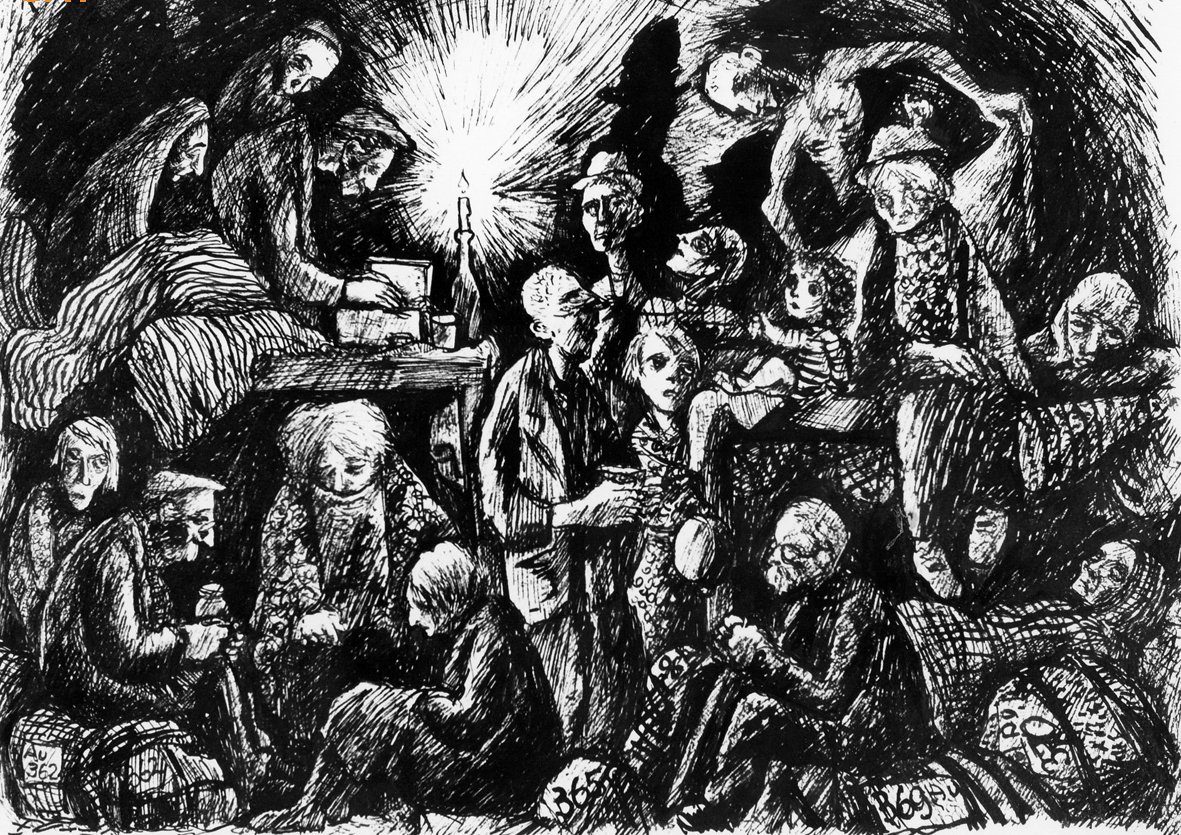
Drawing of the Terezin barracks by Bedrich Fritta via wikipedia commons.
0 Response to "Art in Terezin Childrens Drawings and Poems From Terezin Concentration Camp"
إرسال تعليق